
by Naoko Fujimoto | reviewed by Matthew Thorburn
In her new book, of Women, Naoko Fujimoto presents fresh and engaging translations of waka poems by Japanese women writers of the 7th to 12th centuries—a time, she notes, when Japanese women’s literary writing took flight. The book brings together twenty poems by twenty poets, including well-known writers such as Sei Shōnagon, author of The Pillow Book, and Murasaki Shikibu, author of The Tale of Genji, as well as poets likely to be unfamiliar to many readers.
In fact, even the names of some of these writers are lost to us. As Fujimoto explains in her concise and helpful introduction, during this time many women writers’ names were not documented. They were referred to only as “[Someone’s] mother” or “[Someone’s] daughter,” using the Japanese participle that translates as “of.” (One poet is referred to here only as “Mother of envoys for the Japanese missions to the Tang dynasty, China”—an individual whose poetic voice also comes to speak for a large group of mothers parted from their children in this way.) Fujimoto reclaims this “of” construction in her book’s title, a reminder that the poems collected here belong to the women who wrote them.
The waka is a short poem with a long history. Waka means “Japanese poem”; it’s a type of poem that has been written in Japan for centuries. Originally, waka were usually about nature and responses to the changing seasons, but over time they have been written on a much wider range of subjects. While they originally encompassed a number of different forms, contemporary English-language readers will know the waka (if they do) as a poem of thirty-one syllables, arranged in five lines, using a syllable-count structure of 5-7-5-7-7. The more widely known haiku derives from the first three lines of the waka—and as with the haiku’s 5-7-5 syllable count, English-language translators and writers of waka may dispense with these strict counts in favor of a concision that is stylistic more than numerical. The number of lines can be flexible too. As Fujimoto notes in her introduction, the written waka was “commonly used as household decoration with calligraphic approaches” during the time of the poets translated in her book, “so the line breaks varied from piece to piece and were not historically five lines per stanza.”
Even taking liberties with syllable and line counts, the waka is a compact form, dense with meanings and double meanings, as well as cultural and historical references that may be unfamiliar to non-Japanese readers. While all this could make translating waka into English a daunting prospect, Fujimoto has approached the challenge in a creative way—or really three ways—drawing on her talents not only as a translator, but also as the accomplished author of several books and chapbooks of poetry and a leading light in the expanding field of graphic poetry. In her previous book, Glyph: Graphic Poetry=Trans. Sensory (Tupelo Press, 2021), Fujimoto presents visual interpretations of her original poems written in English, creating what she has described as a “contemporary picture scroll.” In addition, her poetry chapbook, Mother Said, I Want Your Pain, originally published by Backbone Press, will be reissued this year by Bull City Press.
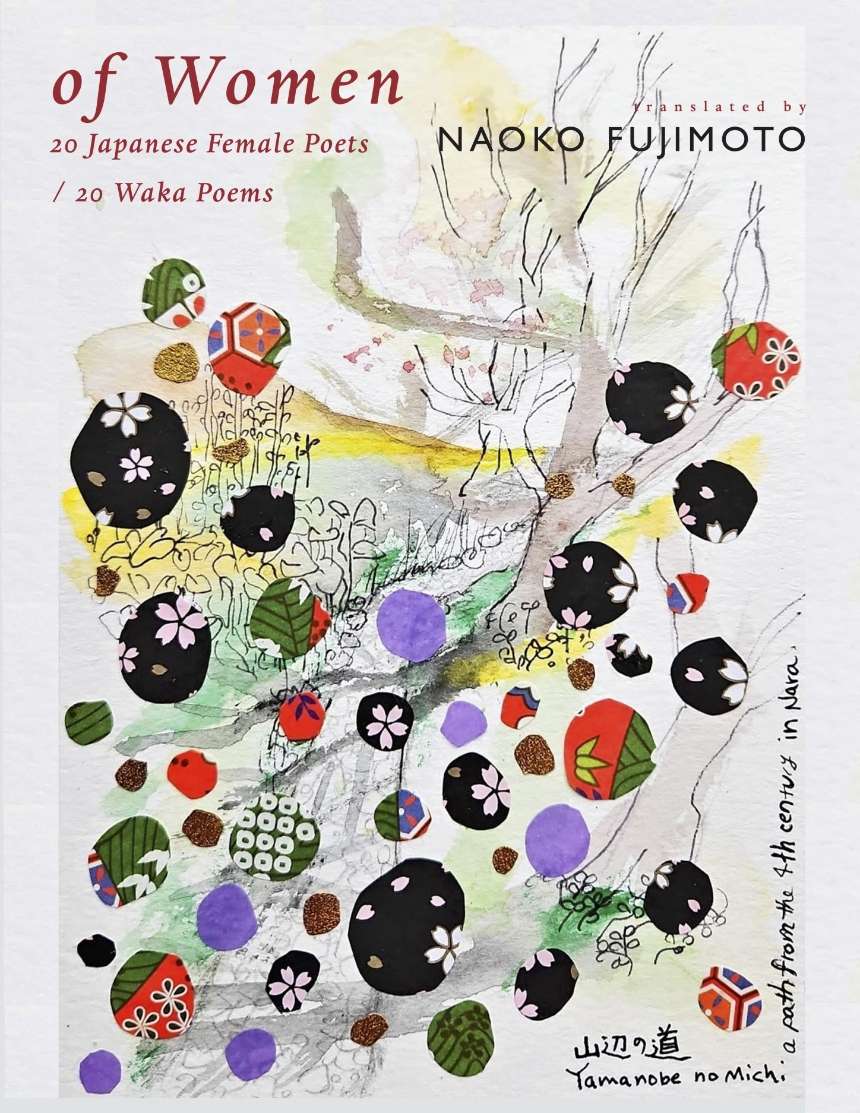
In of Women, Fujimoto offers each waka in a three-part translation. First comes a short prose piece, which helps convey the mood and provide a sense of the emotional landscape of the waka. In this way, it functions much like the prose poem portion of a haibun. To be clear, this part is not a translation; it’s original writing by Fujimoto. Second, there is an English-language translation of the waka. And third, Fujimoto presents a visual translation of the waka—a colorful collage that includes one or more hand-written lines or phrases from the poem—that adds an extra-sensory dimension to how the reader experiences these poems. For each poem, Fujimoto also includes the original Japanese text, a Romanized sentence version of the poem in Japanese, and a brief note that provides further historical context for the poem and (where available) biographical information on the poet.
Having described Fujimoto’s approach, let’s see it in action. Here is her full translation of a waka by Akazome Emon:
The crickets are quiet. Someone walks on gravel. A horse’s hooves. I open the window a crack. Night’s breath tethers me. I close it. A moth flies around my candle and flattens shadows. I blow out the light. What a deep black the moon brings tonight.
I must be already in bed
if you didn’t promise to visit me;
I stare at the moon as it sinks toward the west.
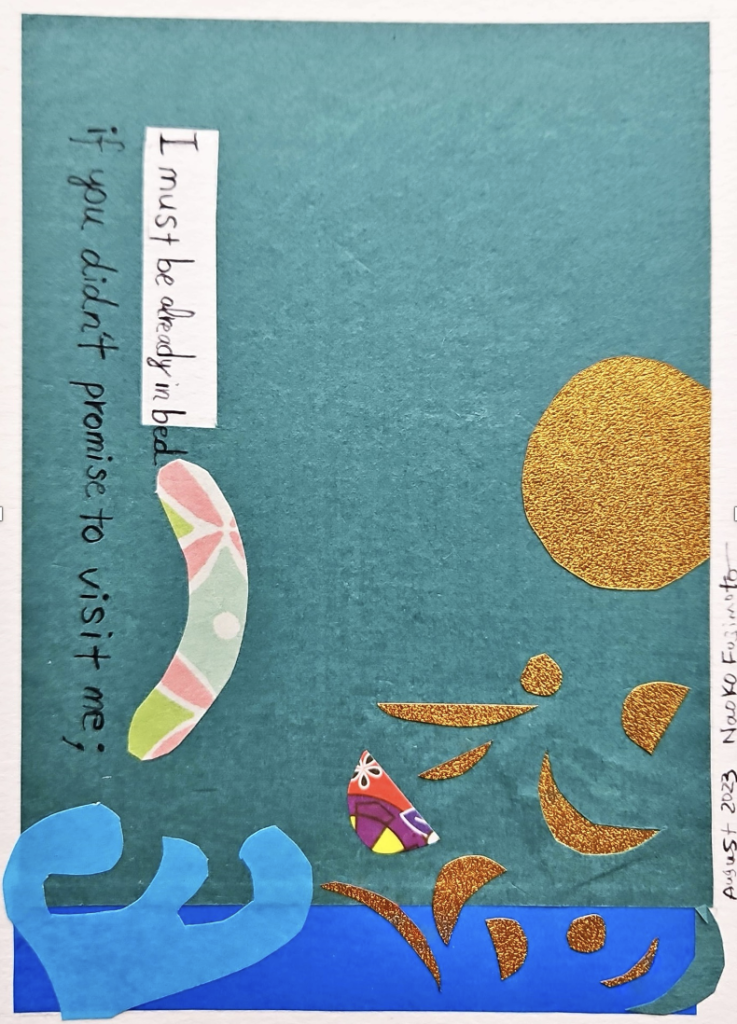
Naive Akazome Emon’s sister often waited all night for Michitaka, who was Takako’s (Gidousanshi no Mother) husband. He was jolly and witty, everybody’s favorite, but some scholars think that he might have had health issues from consuming a lot of alcohol. Akazome Emon often ghostwrote poems for her close friends. By that time, Michitaka had stopped caring for her family. He might have had an affair with Akazome Emon as well.
Akazome Emon became a regular member of Empress Shōshi’s art salon after Murasaki Shikibu discovered her poetic talent. Akazome Emon also might be the main author and editor for Eiga Monogatari, the historical, lyrical fiction about the Heian era. She never served Takako’s daughter, Empress Teishi.
Eventually, Akazome Emon married Ōe no Masahira. Their marriage was dauntless—they shared a charming nickname, Masahira Emon. She wrote this waka to Takako’s husband before she met Masahira.
yasurawa de / nenamashi mono o / sayo fukete / katabukumade no / tsuki o mi shikana
やすらはで寝なましものをさ夜ふけてかたぶくまでの月を見しかな
赤染衛門 / Akazome Emon
As this example shows, these poems, written so long ago, have a wonderful sense of immediacy in Fujimoto’s graceful translations. Like letters or diary entries, they convey feelings of love and, often, the intense longing that comes with separation from a lover. Here’s another—this time from the poet Ukon, waiting for her lover to return—and supposing he may not:
You’ll forget me, that’s fine. My one lament:
Gods may swipe you from this world for your broken promise.
And indeed, Fujimoto explains, a woman and man might exchange waka poems as an expression of their feelings, like love notes. These poems’ immediacy comes through in this translator’s word choices, which sometimes veer into contemporary language that (I imagine) conveys a flavor akin to that of the original in its time period. However, it can also feel a bit jarring. For example, here’s the end of a poem by Daini no Sanmi, in which she reassures her husband of her fidelity:
Cold winds blow from Mount Arima. Ina’s bamboo stems sway.
Unreliable fondness, you said, but I don’t stray. I’m legit.
Beyond lovers’ private messages, the waka has also come to be a versatile form for conveying a range of other feelings—including the particular acute loneliness a mother feels when separated from her child. Fujimoto’s haibun essay leading into the waka “Mother of Envoys’”begins, poignantly, “I wonder if you see the same moon,” and notes that she has “harvested your favorite butterbur sprouts and”— in a wonderful gesture of motherly love—“boiled them to remove the strings.” Such envoys were like exchange students, Fujimoto explains, who made a dangerous crossing over the Sea of Japan; many never returned. In her waka, this mother asks for stand-ins to comfort her faraway son for her:
A traveler sleeps in the field.
If it is snowing,
hold him—my son with your feathers dear celestial cranes.
Waka—like almost all poems—seek to capture a moment, a fleeting feeling, the sensation of stepping once more into that particular river you can never step into again (except, perhaps, in a poem about it). In Naoko Fujimoto’s multifaceted work, a sharp focus on images and revealing details in the original and translated texts—as well as the vibrant colors, shapes and textures of the collages and the immediacy of their handwritten lines—helps make these poets’ work vividly and very visually engaging for English-language readers. Here’s one more, which also appears in full, written out by hand, in a collage of different shades of blue and arcs of dazzling gold paper:
A blink of spring a flap of white cloth
the dazzling leaves laundry hangs by the foot of Kagu Yama
summer is
# # #
Naoko Fujimoto was born and raised in Nagoya, Japan. She is a poet and translator. Her poetry collections are We Face The Tremendous Meat On The Teppan, winner of C&R Press Summer Tide Pool Chapbook Award by C&R Press (2022), Where I Was Born, winner of the editor’s choice by Willow Books (2019), Glyph:Graphic Poetry=Trans. Sensory by Tupelo Press (2021), Mother Said, I Want Your Pain (Backbone Press, 2017 & Bull City Press, 2026), and three chapbooks. She is a RHINO Poetry editor. Her first translation chapbook is available from Toad Press in the fall of 2024. Her full-length translation collection, of Women, is available from Tupelo Press.
Matthew Thorburn’s new book of poems is A Hundred Birds, forthcoming from Louisiana State University Press in Spring 2027. He’s also the author of six previous books, including String, a novel in poems. He lives in New Jersey.