
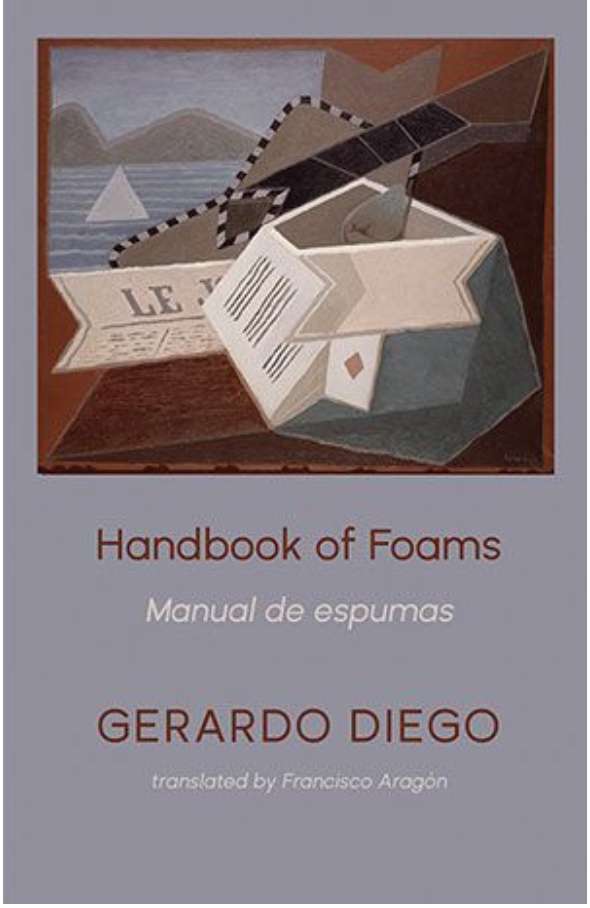
Gerardo Diego’s Handbook of Foams
translated by Francisco Aragón | reviewed by Alexandra Lytton Regalado
Reading Francisco Aragón’s translation of Gerardo Diego’s Handbook of Foams feels like a private, behind-the-scenes museum tour. Aragón is the curator and he opens the door to introduce a major Spanish avant-garde poet to English-language readers; he uses white gloves in the translations—creating an atmosphere of care, intimacy, and artistic kinship. Through his initial contextual essay, the braided personal reflection that closes the volume, and the bilingual versions of the poems at the center, Aragón creates a carefully guided encounter.
Aragón’s curational accompaniment matters because translation itself is never neutral. When we translate a writer, we also tinge their work with our intentions and aesthetic choices. Why this poet? And why now? Aragón’s framing essays quietly answer those questions without becoming overly explanatory. His introduction offers historical and literary context but at no point does he flatten Diego’s work into a list of movements or manifestos. The closing essay opens a more intimate window into Aragón’s relationship with the work, revealing where he was personally and artistically while translating these poems. Through these bookended essays, the reader senses that for Aragón translation is a form of deep listening, an intimate artistic exchange.
The introduction allows a peek into the literary atmosphere surrounding Diego: symposiums, salons, rivalries, artistic posturing, journals, and conversations circulating through Spain and Latin America during a moment of radical experimentation. One of the most illuminating observations in the essay concerns Diego’s relationship to the Chilean poet Vicente Huidobro, who famously said, “A poet is a little god,” and the creacionismo movement that argued that poetry should not imitate reality but create new realities of its own. Aragón highlights Diego’s own distinction between Huidobro’s creacionismo, modeled largely on cubist painting, and his own poetic vision, which added the third element of music “as a guiding star.” This insight becomes one of the keys that unlock Handbook of Foams. These are not poems driven by narrative progression or confession. Nor do they resemble the feverish associative torrents of surrealist poetry. Instead, Diego’s poems move with the strange precision of musical compositions rendered into carefully considered visual structures.
Before reading this collection, I knew very little about ultraísmo or creacionismo, so my instinctive points of reference became the imagistic compression of William Carlos Williams and, interestingly, the poems of Francisco Aragón himself. This artistic affinity became totally clear when I was just five poems into the collection. Aragón seems uniquely attuned to Diego’s restraint, his surgical shifts between images, and his trust in silence and implication. In Spanish, one can hear end-rhyme and subtle sonic echoes pulsing through many of Diego’s lines. Yet Aragón avoids turning the English into something artificial or over-ornamented. Instead, his language remains plainspoken, even stark at times, which paradoxically allows the strangeness of the images themselves to shine more brightly.
This restraint is one of the collection’s greatest strengths. Diego’s poems are imagistic and associative and never saturated. But what appears simple often reveals itself to be quietly complex. The short lines are architectural and are arranged like visual units or cubist building blocks suspended in white space. The poems create atmosphere through juxtaposition of images rather than explanations. In “Table,” Diego writes: “The sea no longer bothers being round // Snatch your mind off death // It isn’t easy getting to the bottom / nor rendering our rug a wheel of fortune.” Though the stark statements of this poem resist paraphrasing, the resulting effect does not lack emotion. The sea’s refusal at “being round” feels playful and destabilizing at once. The imperative to “snatch your mind off death” opens an emotional undercurrent beneath the poem’s seemingly abstract surfaces. Diego trusts the image to carry emotional weight and that trust may be one reason these poems feel so refreshing right now, when so much contemporary narrative poetry leans toward exposition or emotional over-articulation. Diego’s imagistic poems suggest another possibility: that mystery can also be a form of intimacy. When the speaker leaves the door open for mystery, that act shows trust that the reader will relive the poem via their own experiencethat the reader will create their own art, rather than having it drawn out for them.
Many of the poems in Handbook of Foams were written while Diego, only twenty-six years old, lived in a beach bungalow in Gijón overlooking the Cantabrian Sea. Music and water move through the collection as recurring motifs. Oceans, rivers, trains, telegraphs, clocks, roads, bridges, windows, foam, rain, and wind all appear charged with strange vitality. Yet the poems do not unfold with the breathless velocity of dream logic. Instead, they move with a steadier pulse. When we read these poems, we are not swept into a river of associative delirium; rather it is like standing inside a lighthouse beam as it slowly rotates, illuminating one object after another.
This calm and focused observation becomes especially vivid in “Fountain”: “Contraption of love / My faucet versifies better than a nightingale // And it was you and your dress / I drank from every day.” This poem is strange, playful, erotic, and tender all at once. The faucet is simultaneously poet, typewriter, and singing bird. The beloved dissolves into water, into ritual, into language. Diego’s objects are rarely static. They slide, mutate, and breathe. The world inside these poems seems perpetually on the verge of becoming something else.
That sense of movement recurs throughout the collection. Trains repeatedly appear as transitional presences: arriving, departing, crossing through consciousness like fleeting thoughts. In “Lullaby,” Aragón translates: “The train’s expired at the station across the street / and my handkerchief hangs from the highest branch.” Even the word “expired” feels charged with multiple meanings: exhaustion, disappearance, departure, death. In other poems, rivers flow beneath beds, laundresses feed colors into foam, and distant windows threaten to move closer. The world feels on the cusp, unstable and shifting, but never chaotic.
One of the collection’s most striking qualities is the way Diego animates ordinary objects without fully personifying them. Things in these poems seem to possess peripheral forms of consciousness. A shell can stop singing. Foam becomes architectural. Villages pulse beneath their surfaces. Reading the collection creates the sensation that objects continue moving once we look away from them. This uncanny quality becomes especially powerful in poems where sound is center stage. In “Recital,” Diego writes: “Under my bed / flows the river / and on my pillowed sea / the hollowed shell has stopped singing.” The repetition of open vowels and soft consonants creates a physical vibration in the mouth allowing one to feel these poems resonating in the body. Aragón’s translations preserve much of this sonic tactility without forcing the English into artificial poeticism.
Another subtle but important feature of the collection is its structure of dedication. Every poem is offered to someone. These dedications create the feeling that Diego is constantly writing in conversation—with fellow writers, artists, friends, beloveds. Each poem hinges on a relationship and underlines the feeling of poetry as bridge.
As translators we convey poetry across languages to say: this still matters. These images still breathe. These rhythms still vibrate inside our bodies. If poetry is a form of observation, then translation becomes a way of seeing again. That re-seeing feels especially urgent in Handbook of Foams. Diego’s poems via Aragón translation, remain contemporary in their compression, their visual structure, and their trust in metaphor. They remind us that the avant-garde’s rupture and experimentation was also an attempt to reorganize perception—to make the world shimmer differently through language.
After reading the final lyric essay, I imagine Aragón holding Gerardo Diego’s Manual de espumas at a corner table of Madrid’s Instituto Internacional mouthing the words, losing track of time, and upon reading all thirty poems, closing the book to proclaim, “Wow,” into a room now drained of light. I feel that same electricity as I come to the final poem, “Performance,” and read: “The hours go by carrying my luggage / Will I reach the ending on time // Stars shine in shifts // At last // A moment’s been seen.” And when my eyes fall upon that singular period—the first form of punctuation to appear in any of the poems, and I flip to the Spanish version to see if it’s mirrored there, and I find that it is not—my mouth drops. How is it possible that this one tiny decision makes that line clang, gong, and howl? That is Aragón’s white-glove treatment. The book ends with a stage curtain of rain falling over the sea and as I read the last lines, I feel the theater of my own skin slick with salt and the sound of waves roaring their applause.
His poems and translations have appeared in various print and online journals, as well as over twenty anthologies, most recently in, Latino Poetry: The Library of America Anthology. His work as a translator includes four books by Francisco X. Alarcón, as well as work by Spanish poets Federico García Lorca and Gerardo Diego. His translation of Manuel de espumas/Handbook of Foams by Gerardo Diego was published by Shearsmann Books in the United Kingdom in 2026. More recently, he’s been rendering versions of the Nicaraguan poet, Rubén Darío. He has read from his work widely, including at universities, galleries, and bookstores. He’s been a featured poet at the Split This Rock Poetry Festival as well as the Dodge Poetry Festival.

Alexandra Lytton Regalado is a Salvadoran-American author, translator, and editor. She is the author of Relinquenda (National Poetry Series Winner, Beacon Press, 2022), and Matria (St. Lawrence Book Award, Black Lawrence Press, 2017). Her work has appeared in New England Review, The Common, Poetry, AGNI, World Literature Today, and Poem-a-Day, and has been anthologized in Best American Poetry and the Library of America’s Latino Poetry. She has translated several book-length collections of Latin American poetry and serves as series translator for the Alta California Chapbook Prize. A CantoMundo fellow, she is co-founding editor of Kalina press (est. 2006) and associate editor at SWWIM. www.alexandralyttonregalado.com