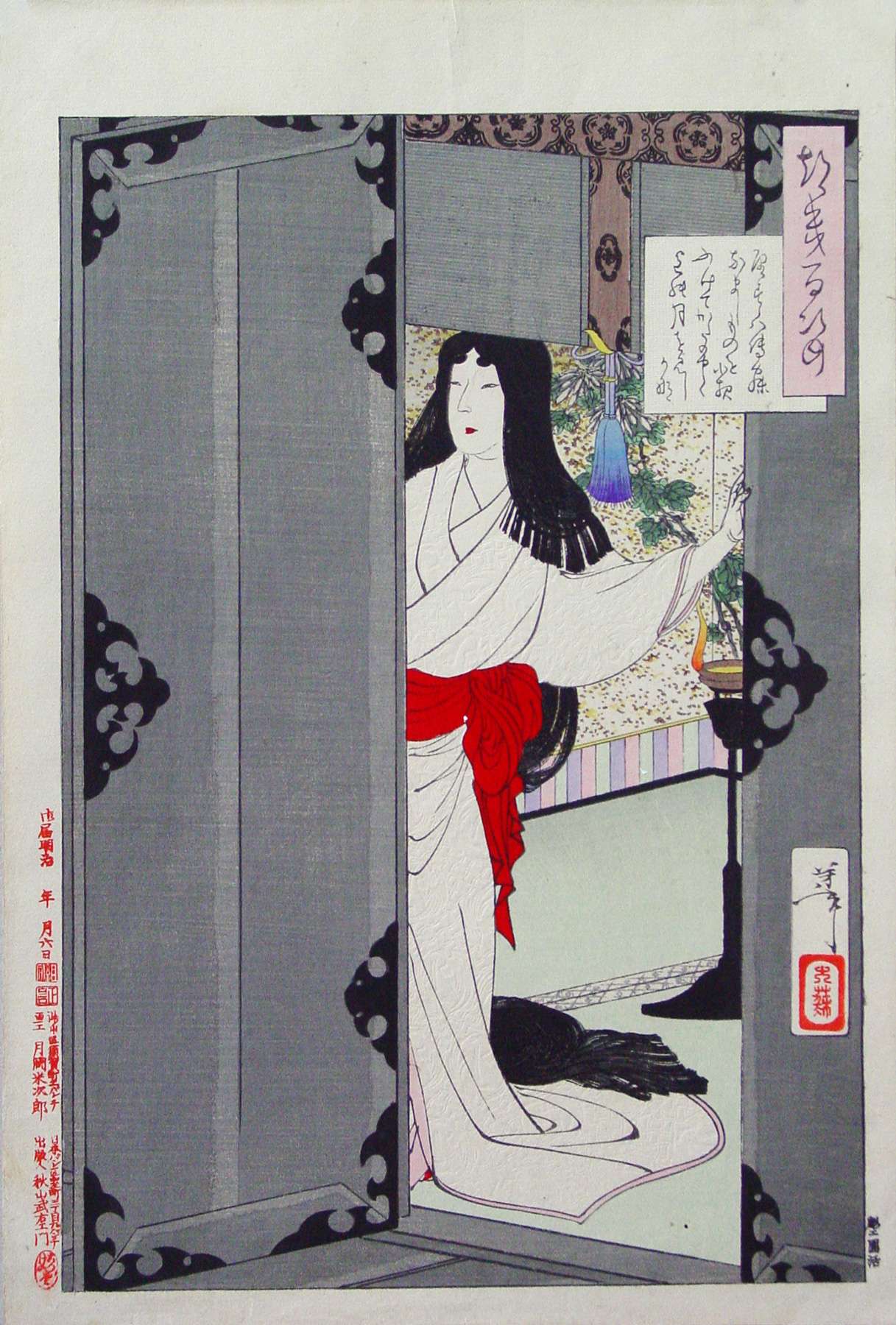
by Akazome Emon | Translated by Naoko Fujimoto*
The crickets are quiet. Someone walks on gravel. A horse’s hooves. I open the window a crack. Night’s breath tethers me. I close it. A moth flies around my candle and flattens shadows. I blow out the light. What a deep black the moon brings tonight.
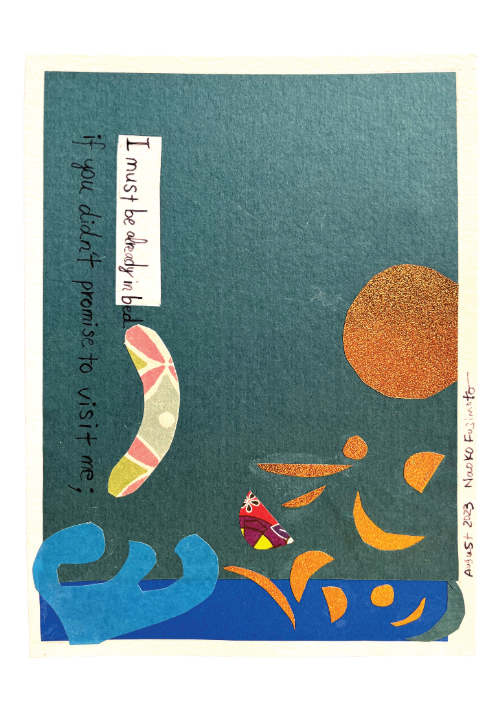
I must be already in bed
if you didn’t promise to visit me;
I stare at the moon as it sinks toward the west.
Naive Akazome Emon’s sister often waited all night for Michitaka, who was Takako’s (Gidousanshi no Mother) husband. He was jolly and witty, everybody’s favorite, but some scholars think that he might have had health issues from consuming a lot of alcohol. Akazome Emon often ghostwrote poems for her close friends. By that time, Michitaka had stopped caring for her family. He might have had an affair with Akazome Emon as well.
Akazome Emon became a regular member of Empress Shōshi’s art salon after Murasaki Shikibu discovered her poetic talent. Akazome Emon also might be the main author and editor for Eiga Monogatari, the historical, lyrical fiction about the Heian era. She never served Takako’s daughter, Empress Teishi.
Eventually, Akazome Emon married Ōe no Masahira. Their marriage was dauntless—they shared a charming nickname, Masahira Emon. She wrote this waka to Takako’s husband before she met Masahira.
yasurawa de / nenamashi mono o / sayo fukete / katabukumade no / tsuki o mi shikana
やすらはで寝なましものをさ夜ふけてかたぶくまでの月を見しかな
赤染衛門 / Akazome Emon
_____________________
*Fujimoto offers the waka in a three-part translation. First comes a short prose piece, compased by Fujimoto which helps convey the mood and provide a sense of the emotional landscape of the waka. In this way, it functions much like the prose poem portion of a haibun. Second, there is an English-language translation of the waka. And third, Fujimoto presents a visual translation of the waka—a colorful collage that includes one or more hand-written lines or phrases from the poem—that adds an extra-sensory dimension to how the reader experiences these poems. For each poem, Fujimoto also includes the original Japanese text, a Romanized sentence version of the poem in Japanese, and a brief note that provides further historical context for the poem and (where available) biographical information on the poet.