On queer ekphrastic poetry—indelible, fierce
by Nicky Beer
I first saw Henri de Toulouse-Lautrec’s “At the Moulin Rouge” at the Art Institute of Chicago in August 2024, the day after the Democratic National Convention had concluded in the city a few blocks away. The gallery in which the painting was displayed was crowded and noisy, and there was an uncanny sense of mirroring as I stared at the green-faced woman in the paining and she stared back at me moody throngs pushing and clamoring at our backs. As remarkable and discomfiting as her expression was, what further drew me in was what looked like a faint crease running down the right-hand side of the painting, just to the left of the woman’s head. It’s not very noticeable in a digital image, as it requires a certain trick of light in the actual room to reveal the jog in the plane of the canvas.
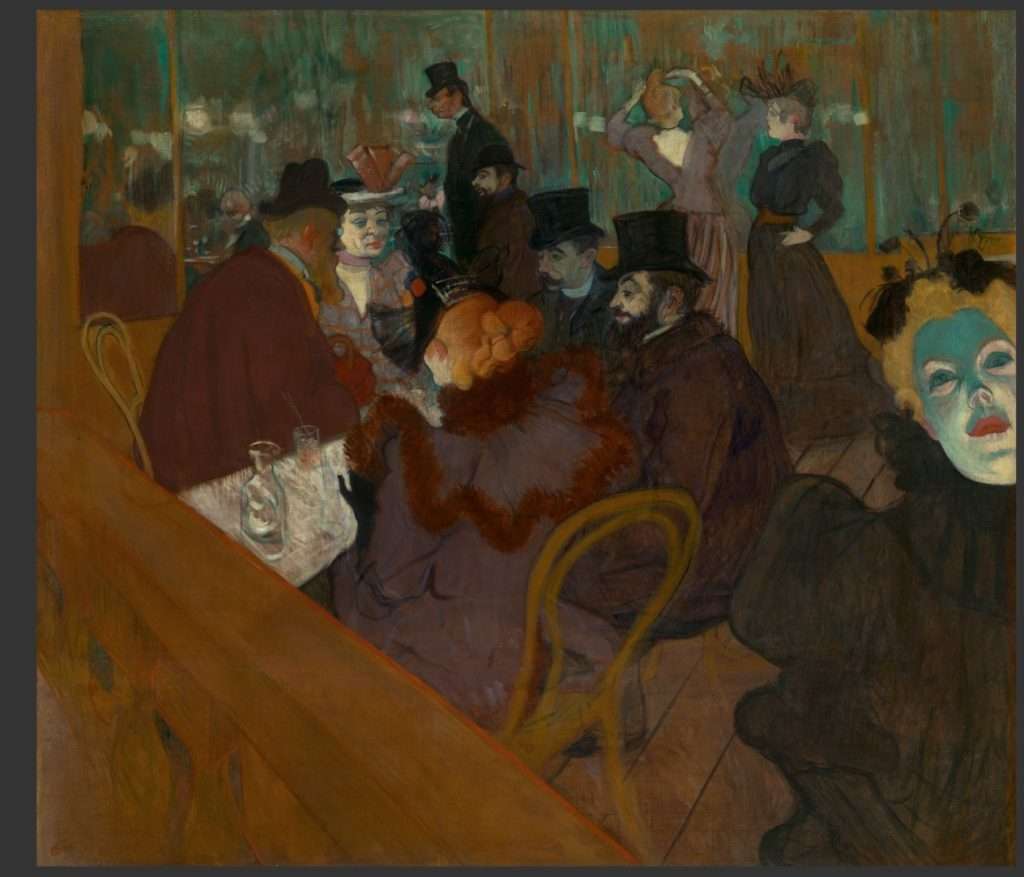
At the Moulin Rouge by Henri de Toulouse-Lautrec
According to the Art Institute, it turns out that at some point in the painting’s history, either Lautrec (who died in 1901) or his dealer had cut the woman out, “perhaps because her strange appearance made the work hard to sell,” before someone restored her in 1914.
The green-faced woman, and her removal, became even more interesting once I learned more about who she was. At least three of the women in “At the Moulin Rouge” were regulars of the famous nightclub who appeared regularly, as well, in Lautrec’s artwork. In the painting, we catch a glimpse in the background of the queer dancer nicknamed “La Goulue” (the glutton), as well as iconic redheaded entertainer Jane Avril. The confrontational gaze of the woman in foreground is that of the performer May Milton. Little is known about Milton beyond her brief dancing career, but she may have been lovers with Avril, who apparently first persuaded Lautrec to include her in his cabaret posters. Milton may also have been lovers with another of Lautrec’s muses, May Belfort.
This painting, and others of Lautrec’s oeuvre, depicts the Parisian demimonde during a time in history that is sometimes considered the “invention” of homosexuality (and by implication, heterosexuality); i.e., when the work and influence of 19th-century European sexologists like Richard von Krafft-Ebing and Havelock Ellis popularized the idea of queerness as an identity category, rather than something that only characterized the sex acts themselves. In other words, queerness became something you were, rather than something you might only occasionally do. And naturally, as these shifts in thinking about sexuality spread throughout the ensuing decades, so did an increased desire by institutions—medical, legal, educational, etc.—to control and pathologize these burgeoning categories of sexuality and gender identity.
Less than six months after I saw the Lautrec, a new administration had been sworn in to the White House and had actively begun erasing queer history. In mid-February 2025, National Public Radio reported that:
The National Park Service website exploring the history and significance of the Stonewall Uprising has been stripped of any mention of transgender people. The page was also updated to remove the “T” from the previously used acronym “LGBTQ+” — now, referring to the community as either “LGB” or “LGBQ.” References to the word “queer” have also been removed.
In June 2025 (yes, during Pride Month), the New York Times reported “the U.S. Navy was renaming the U.S.N.S. Harvey Milk, a fleet replenishment ship that had been named for a Navy veteran and one of the country’s first openly gay elected officials.” And in February 2026, the administration removed the Pride flag from the Stonewall National Monument in New York City. The flag has since been restored, but the precarity of queer history at the hands of the current administration remains clear, to say nothing of the safety and visibility of queer people in public life. And these incidents overlap and are in addition to the multifarious ways that the administration has also sought to erase the histories of people of color from government websites, national parks, and museums. But the crudeness of these excisions, it seems to me, illustrates that we only get louder and more fierce the more they try to cut us out. Is that a bit idealistic? Maybe. But queer defiance has been giving me a great deal of hope and joy lately.
In the poem I wrote in response (see full text below), I feel like I’m doing my own cutting into Lautrec’s painting—not to remove, but to preserve and resituate May Milton into a new reality. I’m using the blade of language to lift her out the painter’s hands and enlarge her beyond the frame. Like many queer makers, I’m stealing what was not meant for me and appropriating it for my own purposes.
I love Milton’s unapologetic monstrousness, how untroubled she is as she floats in her own world, just outside the chaos of the nightlife behind her; I’m using the word “monstrousness” with admiration and deliberateness here. In Lauren Elkin’s book Art Monsters: Unruly Bodies in Feminist Art, she notes that “Monstrous art insists on multiplicity: story is never singular, linear, or straight; the art monster queers story, queers form, queers time.” Central to Elkin’s monster theory is the representation of the body, often female, as subject to inevitable decay, but without being abject. And this, I think is what draws me to Milton—her expression repels both idealization and pity. Her greenness is sickness, reverie, and enigma all at once. And because of this, she becomes dangerous to the viewer. In the beginning of my poem, she starts out as only a grotesque spectacle. But at the poem progresses, the viewer goes from a detached observer, as though peering into a tank at an aquarium, to realizing that they are submerged in the scene themselves, and that they are running out of air before Milton’s indifferent gaze.
Queer ekphrastic poetry, and the ekphrastic work of poets of marginalized identities more broadly, is intent on revealing what is hidden, on not staying silent. It is determined to interrogate and remix tradition. Queer ekphrastic poetry steps into the civilized spaces of the gallery, the museum, of history itself, points its finger, and says here, here, here. Here is the incontrovertible life, here is the desire, here is the pain and joy that thrums through these spaces. Here are the ways in which art remains blessedly unsafe. Here are the ways we are indelible.
Self-Portrait as Woman Cut Out of a Toulouse-Lautrec Painting
“At the Moulin Rouge” (1892-1895)
My forehead somewhere between absinthe and turquoise.
Stiff-cheeked, Medusa caught in her own glance. Ghastly,
ghastly. I have glimpsed something just over your head,
the shot in the horror film before the mutated bat drops
from the ceiling. My monstrosity similarly without shame.
Never before have pink-shadowed eyebrows been so troubling.
Carnelian lips a sharp, sensuous terror. The Moulin Rouge
is a reef behind me: oystershell profiles, anemoned boas.
Sleeves puffed with hypnotic toxins. Predatory hats.
A miniature shark circles inside a half-filled snifter.
The other faces here at least allow you the privacy of your own gawk.
But the oval floating above my collar disrupts any peace.
Your lungs crush. I’m lost in the hours to come, when my copine
will crack the door, her red dress frenzying the dark.
Trapped and absent in my gaze, no wonder you had to take
out your knife.