
Eleven Parts of Feelings
by Nguyễn Quang Thiều | translated by Martha Collins
I
My heart beats in the first spring,
On the vanished paths of my childhood.
A human call is running
Along the edges of sleeping grass;
I am hurting with my first hurt.
I hide a sexless love behind
The flap of a schoolboy’s shirt.
On a day when my mother’s shadow
Has disappeared, I cry in silence.
Hens peck at the pocked face of dusk.
Let me kneel
And silently
Throw things away.
My eyes have been under the spell of love
Since the days when my hair was not yet grown.
II
As coffee cools
Its color darkens.
My thoughts are wet,
My thoughts are dry.
A cigarette has been burning since I was fourteen;
My father’s whip cuts the cigarette smoke in pieces.
An angry say is fixed in my mind with tears,
Though I cried just once, and now my eyes are dry.
Smoke fills my lungs;
A watersnake creeps up my throat.
Where is my father’s whip?
Where is my father’s whip?
All my life I have groped in smoke.
III
The woman, fourteen years older than I,
Has had more time to cry.
In my arms, she cries for the time she doubted.
I return to the gate of dusk,
To the time when my navel cord was uncut,
To the time when I was a green drop of water.
I touch the great vow
Ringing fiercely from the dark side of the sun.
IV
Finally, in a dream, I stood
On my feet, my paralyzed feet.
It’s a painful distance from where I stood
To where there are knocks on my door at night.
Where there’s a harvest of crying
Where there’s a dry season of laughter
Where women’s breasts root in the stony soil
Turning browner with each rumble.
I still can’t open the door in my dream
Though I’ve dragged my feet through half of my life.
My eyes, my eyes
Are always in a hurry.
V
A naked madman walks the streets;
His freedom threatens all freedoms.
Millions of years ago: dancing and howling.
Millions of years later: dancing and howling.
Hunger is not hunger.
Thirst is not thirst.
Pain is not pain.
With the shame of a woman passing the madman
And the shamelessness of the madman
Before the people and the sun,
I paint the eyes of humanity as a hexagon.
VI
It’s not fever imprisoning me,
It’s not weakness imprisoning me.
The winter window opens without a sound.
I meet my mother when she was seventeen—
The teeth of a worn wooden comb bite her hair.
I meet my father when he was twenty—
Pieces of green wood break from his axe
With the laughter of fire.
The winter window opens without a sound.
The shirt of my newborn daughter flies by—
It’s the mocking laughter of time.
VII
In my arms you frisked like a fish.
When I ran away on a moonless path,
You escaped the hook and slid into the mud.
Restless, I’ve been trying
To remember your face but I can’t.
Gills open and shut, filling my chest;
A fishtail frisks and splashes, scalding my face.
Years later, many years later,
I still curl up at night,
An abandoned hook
Trembling before your lips.
I didn’t deceive you,
I didn’t deceive you.
But bait is still hiding beneath
The shining sleepless water of my life.
VIII
Father!
I called out, and then I was ill.
Solitude grew up on me.
I cried often, in silence—
I didn’t need to cry behind my fingers.
I loved wildly, running from sadness and pain—
No mark is left by wet kisses,
No dust rises from falling onto the bed.
A dog’s teeth graze one side of time,
Warm ashes cover the other.
Something is wrong;
I tremble with fear, hearing
Your heavy breath early this morning.
Father!
I wronged you once, long ago, when I lied.
But i wrong you for the rest of my life
Telling you the truth early this morning.
IX
When mist drifts over the yellow dusk
I long to see myself in the last light
In the crack of the door.
It’s the only human road, I think.
It’s the last thing to believe in, in this world.
My hair is sticky-wet like the hair of a newborn,
My fever rings with the tune of the last music.
There’s a red ant in the last streak of light
Creeping into my fever.
X
Like a waterdrop splashing into a deep well,
For twenty years every root of my hair
Has hurt me every moment.
I writhe in the rolling circles
Your ten fingers hurt in ten directions
Like ten claws grasping a dry branch
When an oriole is shot.
I deny your frightened face,
A magic shadow behind the kitchen door.
Where did the golden ring go?
Wounded, I try to find it, outside the light.
XI
On my writing desk the paper knife
Is the teeth of a smiling stranger.
The cry of a cricket imprisoned
In the corner of the house opens a path
Through wild grass to suburban fields.
I am a clump of moss, old and new,
On the wall of the little ancient temple.
The pile of grapefruit leaves has not burned for ten years;
For ten years I’ve been pressed back to my childhood.
The lovely wounds have been asleep
But now the mouth of a wound opens two pink petals.
Something stirs in the veins of the wall,
Something glides on the smile of the knife
Like a swan on a lake.
Pain is less than. . . less than. . .
Pain stands up reluctantly
In the laughing light of the sharp knife
And in poems.
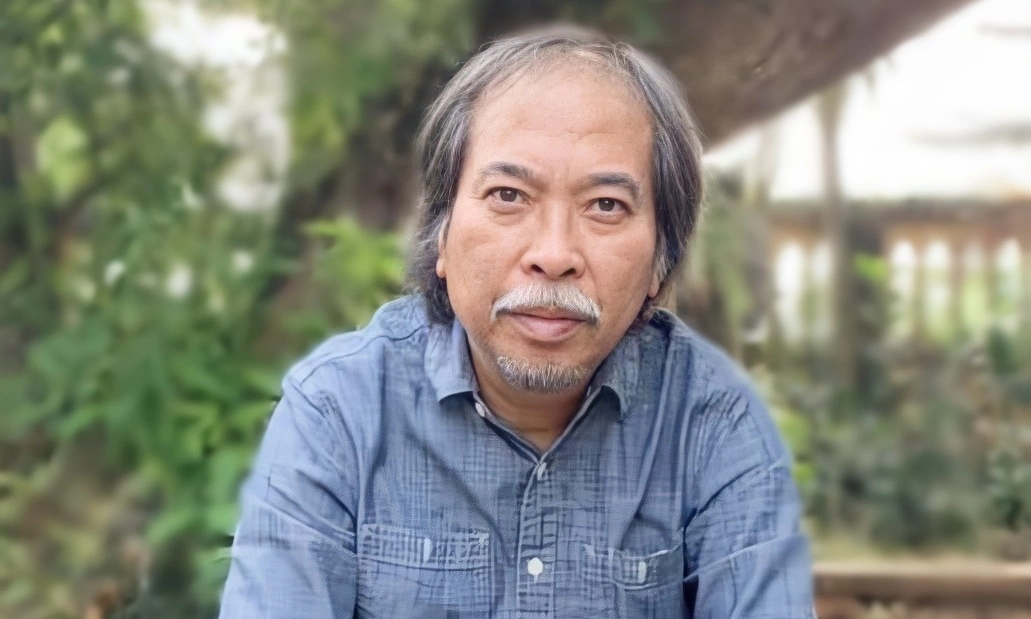
Nguyễn Quang Thiều, poet, writer, playwright, translator, was born in 1957 in Ha Tay province, Northern Vietnam, and educated at Hanoi University in Hanoi where he later has been based. He began to write poems in 1982 but not published until 1990, after a period of five years (1984-1989) he spent abroad, in Cuba, to study Spanish and English. In 1990, he published his debut poetry collection “Ngoi nha tuoi 17”. His second collection of poetry “Su mat ngu cua lua”, followed in 1992, won the prominent Writers’ Association National Award for poetry in 1993. In 1997, “The Women Carry River Water”, a translation version of his poetry collection “Nhung nguoi dan ba ganh nuoc song”, co-translated and edited by Martha Collins and himself, was published bilingually in facing-text format by University of Massachusetts Press (Martha Collins is a professor at University of Massachusetts, Boston). The book has won him the following year the award by National Translation Association of America in 1998. “The women carry river water” is believed to be the first English translation of a poetry collection by a Vietnamese writer of the post-1975 generation (1975 marks the fall of Saigon). A number of poems in the collection have appeared in many literary magazines abroad. Also in 1997 and 1998, two collections of his short stories were translated into French and published in France: La fille du Fleuve (l’Aube, 1997) and “La petite marchande de vermicelles” (l’Aube, 1998). Nguyen Quang Thieu has also been interested in movie and theater, wrote a number of dramatic pieces which were staged, and many of which have been made into movies. Along with his plays, his novel “Ke am sat canh dong” was also made into a movie titled “Chuyen lang Nho” by Vietnam Television. The movie was aired in 1998 via VTV channels. His publications include poetry collections, novels, short stories and plays. Nguyen Quang Thieu is living in Vietnam.
Martha Collins is the co-translator of Dreaming the Mountain and Black Stars. She has also published eleven volumes of poetry, most recently Casualty Reports and Because What Else Could I Do, which won the Poetry Society of America’s William Carlos Williams Award. Her previous books of poetry include the paired volumes Day Unto Day and Night Unto Night, as well as a trilogy of works that focus on race, beginning with the book-length poem, Blue Front. Collins has published three additional volumes of co-translated Vietnamese poetry and coedited a number of volumes, including, with Kevin Prufer, Into English: Poems, Translations, Commentaries. Founder of the creative writing program at the University of Massachusetts Boston and former Pauline Delaney Professor of Creative Writing at Oberlin College, Collins lives in Cambridge, Massachusetts.