
Mama Ana Paula Also Writes Poetry
by Hu Xudong| translated by Katie Farris and Ming Di
A tobacco of corn husks in mouth, she throws a thick poetry book
at me, “Read your Mama’s poems.”
This is true, my student
José’s mother,
two Brazils on her chest, a South America on her bucks,
a stomach full of beer, surging like Atlantic,
this Mama Ana Paula
writes poetry. The first day I met her, she lifted me
up like an eagle
catching a small chicken, I wasn’t informed She Writes Poetry.
She spat at me her wet words, and rubbed
my face
with her big palm tree fingers. When she licked my
panicked ears
with marijuana tongue, I didn’t know She Writes Poetry.
Everyone including her son José and daughter-in-law Gisele said
she was an old Flower Silly, but no one
told me She Writes Poetry.
“Put my teacher down, my dear old Flower Silly.” José said.
She dropped me, but went on
vomiting “dick” “dick,” and catching “dick”
in the air with her lips. I looked at her
back, strong like hairy bear that kills
a bull even when she’s drunk, and I understood:
She Writes Poetry.
But today, when I followed José into the house, and caught a glimpse
of her lying by the pool
with four limbs stretched out, smoking, I didn’t think She Writes Poetry.
I ran into a ponytail
like Bob Marley, a muscle guy, in the living room, Gisele told me
that’s her mother-in-law’s guy from last night, I didn’t think, even if
you stick me in front of a National Army of China and shoot at my little torso,
that Mama Ana Paula
writes poetry. But Mama Ana Paula
Mama Ana Writes Poetry Paula
writes poetry
which burps and farts. I leafed it through page after page
Mama Ana Paula’s poetry book. Yes, Mama Ana Paula writes poetry
indeed. She doesn’t write fat poetry, liquor poetry,
marijuana poetry, dick poetry, or muscle poetry of muscle guys.
In a poem called “Three Seconds of Silence in Poetry”
she wrote: “Silence in a poem, give me a minute and in it
I can spin the nine yards of sky.”
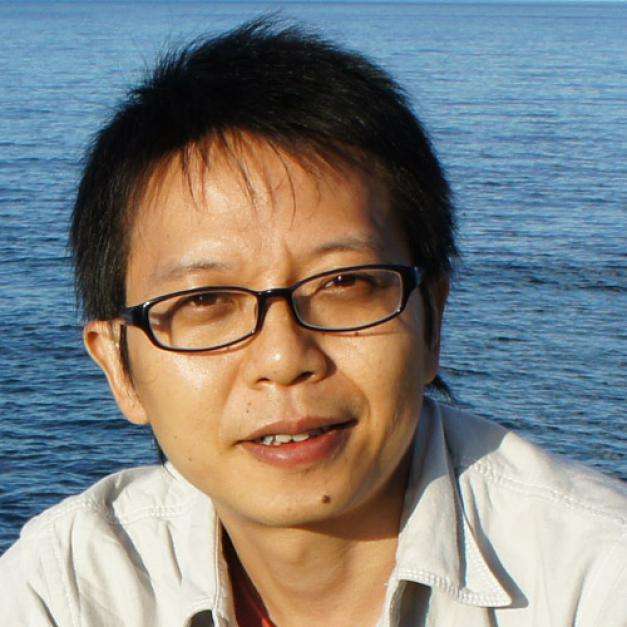
Xu Hudong (胡续冬, Continuing Winter), pen name of HU Xudong (胡旭东, Sunrising East) (30 October 1974 – 22 August 2021), was a Chinese poet, critic, essayist and translator. He received an M.A. in Comparative Literature and Ph.D. in Chinese Contemporary Literature from Peking University, where he worked at the same university both as an associate professor in the Institute of World Literature and as the vice-director in Center of Brazilian Culture. He published 8 books of poetry, 3 books of essays and some translations of poems and poetry critique. His poetry has been translated into English and Spanish and has been included in several anthologies. He was a visiting professor at the University of Brasília (Brazil) from 2003-2005, participant of the International Writing Program at the University of Iowa (U.S.A.) in 2008, poet in residence of the Hermitage Artist Retreat in Florida in the same year, visiting professor at the National Central University of Taiwan in 2010, organizer and host of Chinese Culture Forum in Hannover Messe 2012. He was invited to the international poetry festival Cosmopoética 2012 in Córdoba (Spain), Asian-Nordic Poetry Festival 2013 (Finland/Norway) and Pacific Poetry Festival 2013 (Taiwan). He has also been a part-time TV host, a columnist for newspapers and magazines.
Katie Farris is the author of boysgirls, (Marick Press, 2011), a hybrid form text which has been lauded as “truly innovative,” (Prague Post), and “a little tour de force” (Robert Coover). She’s a co-editor of Gossip and Metaphysics: Russian Modernist Poems and Prose (Tupelo Press, 2014), and has also co-translated several books of poetry from the French, Chinese, and Russian. Her translations and original work have appeared in anthologies published by Penguin and Greywolf, as well as literary journals including Virginia Quarterly Review, Western Humanities Review, and Hayden’s Ferry. She received her MFA in Literary Arts from Brown University. Currently, she worked as an Associate Professor at the MFA program at San Diego State University as well as a core faculty member at New England College’s MFA program.
Ming Di is a Chinese poet based in the US with six books of poetry in Chinese and four in collaborative translation including River Merchant’s Wife (Marick Press, 2012). She attended Boston College and Boston University and taught Chinese at BU before moving to California. She has translated many poets from English to Chinese including Marianne Moore, Anne Carson, etc. She edited and co-translated New Cathay: Contemporary Chinese Poetry (Tupelo Press, 2013). She selected and translated with Neil Aitken The Book of Cranes (Vagabond Press, 2015) and with Jennifer Stern Empty Chairs – Poems by Liu Xia (Graywolf Press, 2015). She co-founded Poetry East West journal and serves as the China editor for Poetry International Rotterdam.