
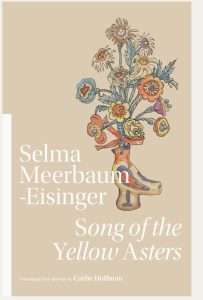
Song of the Yellow Asters
translated by Carlie Hoffman | reviewed by Jenny Grassl
The translator tells us that Meerbaum-Eisinger’s father died when she was not yet two years old, leaving her mother in poverty. Despite these hardships, and despite her young age, she participated in the literary world of Czernowitz, which included her cousin, Paul Celan. At her grandparents’ house, she and fellow poets and friends spent many evenings discussing German poetry. Romanian was the official language of her schooling, but German was “the language of her imagination.” The book includes her own translations of poems by Itzik Manger, Paul Verlaine, and others.
In the first poem of the book, written in 1939, we learn of Meerbaum-Eisinger’s lover who has rejected her. As the book unfolds, this does not stop her romantic imagination from fixating on him; the greatness of her loss rivaling her desperate wartime situation in Czernowitz as a subject for grief. Days before her deportation she entrusted her penciled manuscript to a friend, with instructions to give it to her ex-lover. It was delivered, but he gave it back to the friend for safekeeping. He left secretly for Palestine, but his boat was torpedoed and he was among those who didn’t survive.
In Man’s Search for Meaning, Viktor Frankl wrote about his experience as a holocaust prisoner in WWII, and how for all the prisoners, having a deep reason to live, often a loved one, was essential to not giving up, and survival. Perhaps the unrequited nature of her love was fatal. And yet, the poems survive even death, articulated by the strength of her love. They survive to us as lyric wonder in the face of loss. She writes of nature and its language of hope and regeneration in poem after poem, always tinged with the sadness of her personal grief and the collapse of the political world around her, though there is almost no overtly political writing. One wonders if this was because of fear, and self-censorship. She communicates sorrow and joy, having meaning for us as we contemplate and navigate the uncertain times of a contemporary authoritarian regime that includes the disappearance of innocent people to inhumane prisons, slaughter, and the specter of war.
The lover is directly addressed in the opening poem titled “Song”: “Today you hurt me. Today you told me: go. I went.” In the same poem she tells us, “Today is beautiful.” Throughout the book, the language is simple and authentic, using imagery from nature. Repetitions of rain, snow, leaves, clouds, flowers, and sun are employed like musical motifs, varying and working to cumulative effect, a landscape of emotions. One wonders: which is sadder, the constant rain or occasional sun? Beneath even the sunshine, a darker melancholy broods: “The rain drones on, accompanies my song. If you listen to / the song of rain, you’ll be intoxicated by the pain—you / are hearing my music.”
What strikes me about this book is the isolation of the speaker inside her love story. It rings true: new, young love excludes the world, though it lives so deeply in it. The poems offer few other people. Once, a father is mentioned, but we know that her own father died when she was very young. There are people in a dance in the poem “Gilu”; otherwise, there is nearly no one. The past does not seem to exist back before the time of the lovers. Nature exists as an abundant present, populated with small- and large-scale life forms, from seed to sky, each coded with feeling. The future is almost too hopeless to take into account, yet she insists on hope.
Writing about nature must have been a fairly safe subject for the young writer, rather than describing war. Somehow, the war appears with an elephant-in the-room enormity, by almost-omission. I wonder if the title poem Yellow Asters is an echo of the yellow stars that were Jewish badges. Aster comes from the Greek word for star. Meerbaum-Eisinger uses a recurring image for the lack of people, an “empty bench,” or a “sun-drenched bench,” symbolizing the absent lover, but also the absent past, future, and other people.
Crystal
All is still. A flock of fallen leaves,
brown gold, soaked in sunlight.
Chalky clouds hang from th cobalt sky.
Frost-jeweled trees.
Crisp, green pines—tops of trees
needle skyward and copper beeches,
wiry and brazen, listen:
an eagle floats overhead calling,
and the trees stretch higher and beyond.
Sometimes a lonely bench, and here:
a little plot of grass, half-frozen,
the sun has chosen to adore.
December 8, 1940
In Czernowitz’s Jewish ghetto confinement, conditions were overcrowded, sometimes thirty or forty people sharing a room, with deplorable sanitary conditions, and always under the threat of deportation to camps. Perhaps Meerbaum-Eisinger found a basement or a corner to write in, in solitude. She speaks often of silence. Or the crowding begat solitary poems. Did she have a window? When could she be outdoors? Or perhaps most of the images are memories. This collection inspires speculation, because of the intimacy and lyric quality of the poetry. We feel close to the speaker and her life, and we want to know more. One thing we know: her young life was unrealized potential. And yet she created this testament to love, life, beauty, and above all humanity. There is so much youthful exuberance as well as quiet reflection, in her writing in adverse, dehumanizing conditions:
From “The Chalice”:
“So it stands there: sparkling and slim / like a naked maiden emerged from the sea, and its light dances, spins, jingles / brightly as a thousand sleigh bells.”
From “Chestnuts”:
” I take one and place it in my hand, / gentle and tender as a child, / I think of the trees, the wind / singing softly through the leaves, / and how, to the chestnuts, this quiet music / is the summer slipping past, leaving / just this sound as a last goodbye. “
In fairytales and lullabies singing the self-soothing of a child:
“a child knowing death is close…the final snow.”
Music vibrates within the poems, and musical references abound. In “Sonnet,” about “the bow’s melodies”: “I cannot hear them / I am so tired. / So I stand and resonate.” Like the wood body of a violin or cello. Playing a song on the piano, she writes that she cannot find the music she is seeking. It is too much, or not enough. Finally, she locates one key that is the problem—it makes no sound and the result of the whole is “hollow and gray”: “You hear the unplayed note forever, / fear the happiness that grazed you / on noteless nights held by the moon, the silence / where the meaning of your tears goes missing. ”
Again, one questions, how would it have been to have the loved one near, or at least for there to be love felt between both people, even if far away? Perhaps it would only magnify the cruelty of death. The book reminds us:
In this line from an untitled poem:
“You are life’s beauty, my only one / for whom I endure: my loneliness.”
In “Dreams”:
“All these blossoms turn to kisses, / hot as red wine / and sad as butterflies that know they must / perish in the dying light.”
In their themes of nature and romantic love, Rainer Maria Rilke and Heinrich Heine were influences. She studied their poems and echoed their connections to nature and romantic love. Meerbaum-Eisinger may not have been exposed to Emily Dickinson, but her work of longing and the natural world as emotions resonates with the American poet. Meerbaum-Eisinger wrote in rhymed poetry, but the translator has given us evocative unrhymed lines.
The title poem of the book, “Song of the Yellow Asters,” inspired me to research ‘yellow asters,’ never having seen or heard of them. I discovered that far more common than ‘yellow asters’ is something called ‘Aster yellows,’ a disease causing bizarrely deformed flowers, yellowed leaves, and death of the plant. The word in German is Astern gelbsucht, or Aster jaundice, and was used as early as the 1920s. It is a bacterial disease caused by infected leafhoppers. The question I have is: was she thinking of this as the shadow story for “Song of the Yellow Asters?” And was she thinking, previously noted, of the identifying, demeaning yellow stars for Jews?
In this 1941 poem, for example, from early in the book:
“They gaze at me brightly through the rain, / a brightness replacing the sun for me. / My blazing yellow smile rain’s sorrow can’t swallow. / Laughing, they bow down into the green. / where their pure and fresh notes / accompany me— / I place my song at their feet / because today brings me joy.”
Or, here, the last poem in the book, “Tragedy,” dated, December, 1941
“The hardest thing: to give yourself away / while knowing no one needs you . / To give yourself completely and realize / I will fade like smoke and vanish.”
Fading like smoke leaves the air changed. It is this air Meerbaum-Eisinger’s poems bequeath us, the breath of one young woman’s poetry from a critical time in the history of the world. It is a significant contribution to the literature of the Holocaust. Her co-presence with the natural world speaks to us as a source of peace amidst unspeakable turmoil. The giving of herself completely, in love and poetry, will survive in her personal story, and perhaps will not be in vain as it connects to the larger story of humanity—life and death—that she believed in to the end. We owe gratitude to translator Carlie Hoffman for bringing these poems to light in the beautiful bilingual edition.
Carlie Hoffman is the author of three poetry collections: One More World Like This World, When There Was Light (winner of the National Jewish Book Award), and This Alaska (winner of the Northern California Publishers and Authors Gold Award in Poetry as well as a finalist for the Foreword INDIES Book of the Year Award), all from Four Way Books. She contributed translations of Anneliese Hager’s poetry to the monograph, White Shadows: Anneliese Hager and the Camera-less Photograph (Atelier Éditions, 2025). Her translations of Rose Ausländer’s poems are forthcoming. A 2024 Convent Arts Fellow, her honors include a 92NY “Discovery”/Boston Review Poetry Prize and a Poets & Writers Amy Award. Hoffman’s work has been published in Poetry, Academy of American Poets’ Poem-a-Day, Los Angeles Review of Books, and many other venues. She is the founder and editor-in-chief of Small Orange Journal.
Jenny Grassl lives in Cambridge, Massachusetts. Her poems have appeared in Ocean State Review, The Boston Review, Tupelo Quarterly, Bennington Review, Poetry International, Lana Turner Journal, Laurel Review, Fairytale Review, and others. She was a runner-up for The Boston Review Annual Prize, selected by Mary Jo Bang, and a finalist for The National Poetry Series. Magicholia, her first book, was published in 2024 by 3: A Taos Press. Her second book, Forever Mistaken for Ourselves won publication by Tupelo Press in their July Open Reading period, and is forthcoming in 2026