
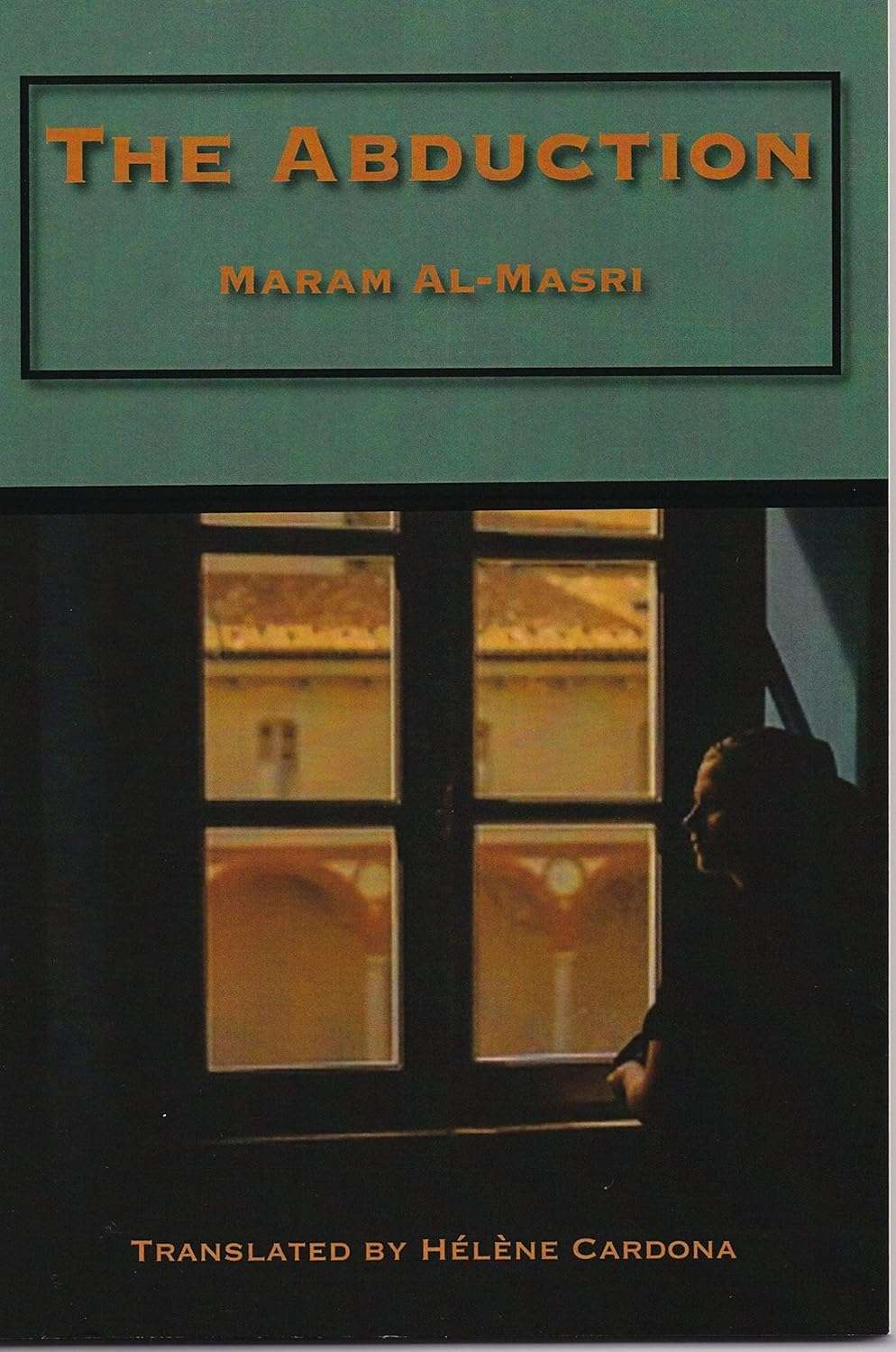
by Maram Al-Masri | Translated by Hélène Cardona
Reviewed by Sam Yaziji
On its surface, Maram Al-Masri’s The Abduction laments the deceptive, predatory grip of geopolitics over familial bonds. It expresses how the geopolitical specter can possess someone—an absent ex-husband—who abducts the narrator’s son and takes him from France back to the poet’s home country of Syria. In the opening poems, the narrator depicts certain warm, mundane memories charged with a pantheistic, almost ecstatic kind of love. The images are simple and elemental. In “Come on, sun” (27) she implores the sun to “Let your yellow hair float / over the shivering shoulders of the earth.” In “Dance, dance” (29) she implores her son to dance, so “that the restless heart of the world / may calm itself / to the rhythm of your steps.” The form of these early poems—motherly petitions for the solar cosmos and beloved child to calm the maladies of a chaotic, cold earth—carry a latent foreboding. The poem “With these two hands” (31) depicts the abduction through memory-bearing objects (a suitcase, a water bottle, and a stroller) which the unknowing mother has packed for her husband to take on an apparently-brief trip with their son—“to this day / my little one’s stroller has not returned.” This sense of paternal deception tortures the speaker throughout the rest of the book.
The poems of the second half of the collection are plain and direct—there is no effort to obfuscate, veil, or abstract her emotions. They are piercing in their unpretentious, elegiac viscerality. They are addressed to a silenced subject—a child who cannot contact his mother—and the poem “I sent you” (36) expresses this most tragically: “I sent you my love / by mail… / Did you receive the package?” Now, the possessed father begins to loom over the narrative, and her lexicon reflects this, inhabiting the spectral register of shadows, memories, silences, souls, and interrupted sleep. The speaker retreats into herself, into her shattered psychological routine—she returns home, sleeps, and wakes up, with a single-minded obsession over her missing son: “every morning I wake… / having fragmented my sleep / to smithereens” (“Every morning,” 41). The narrator herself begins to deteriorate in this anxious desperation—she describes the feeling as an uncomfortable, chilling stasis: “I look out a window… / The world is cold” (“I no longer have the patience,” 48). Implicit in this lamentation is an acknowledgment of the failure of the sun to warm the cold earth of the collection’s first half—the world is no longer charged with light, or love, or much of anything. “Dusk no longer has your eyes” (51), the best poem of the collection, attests to this frigid reality: “My dusk no longer has trees / sway in its shadow / since you’ve been gone.” The poem carries the platonic immediacy of Vasko Popa’s chillingly truncated love verses in “Far Within Us,” and the surreal longing of (fellow Syrian) Nizar Qabbani’s aphoristic love poems.
While today’s reader might consider these poems as a purely contemporary, confessional offering, I see them situated seamlessly within the ancient tradition of Syrian poetics, which stretches back to the genesis of human literature. Most of the poems are just a handful of stichic lines, and many even resemble the tragic epigrams of antiquity—a form practiced by Syrians since the classical age. Meleager, a Greco-Syrian poet of the 1st c. B.C., carries a similar, fiery longing for his lost subjects as Al-Masri, and writes in equally direct and evocative verse. He questions: “O briny wave of Love, and sleepless gales of Jealousy, and wintry sea of song and wine, where am I being carried?” (Greek Anthology 5.190, trans. Paton). The strength of Al-Masri’s poems is that they often profess a timeless, universal, and perennial power—the maternal speaker could be a mother in any era: “I had a child… / I nourished him with my blood… / He was torn from my arms / I stopped singing” (“O human brothers,” 32).
As a Syrian-American, I consider these poems exemplary for the current crossroads Syria finds herself standing before. Our country has been abducted time and time again by geopolitical titans—powerful neighbors who reign for a few decades before being ousted in reactionary violence. It is hard to find hope for Syria in this period, where elections have been suspended for four years, Alawites and Christians (the country’s besieged minorities) have been summarily executed, and churches and mosques have been vandalized and damaged, but Al-Masri’s book gives me hope that Syria’s artists will continue to be dignified, direct, and unpretentious in their struggle for justice and peace—the peace of self-determination, the sovereign peace of a mother caring for her son. In the final poem of the collection, an ars poetica titled “The Bread of Letters” (66), Al-Masri perfectly summarizes the Syrian poet’s precarious, but resilient position: “To write / is to live on the cliff’s edge / clinging to a blade / of grass.”
Maram Al-Masri was born in Latakia, Syria, and moved to France following the completion of English Literature studies at Damascus University. She is the recipient of many prestigious literary prizes, including the Prix d’Automne de Poésie de la Société des Gens De Lettres, the Adonis Prize, the Premio Citta di Calopezzati, Il Fiore d’Argento, and the Dante Alighieri Prize. Her collections include Je te regarde, Cerise rouge sur un carrelage blanc, Par la fontaine de ma bouche, Elle va nue la liberté, Je te menace d’une colombe blanche, Le Rapt, and two anthologies, including Femmes poètes du monde arabe.
Sam Yaziji is a poet, writer, and editor from Miami, Florida. He is currently an MFA student in poetry at San Diego State University, where he received the Presidential Graduate Research Fellowship. His poems have been published in Zone 3 Press (forthcoming), Attic Salt, and Passage Prize Vol. 1. His research interests include Eastern Christian hymnography, wartime poetry, and cybernetics. He also paints Byzantine icons.